DNA test
5’ g cap- Guanine cap at the 5’ end of the RNA
Anticodon - base pairs with a complementary codon on the mRNA
Base- Pair substitution - when the point mutation results in replacement of a pair of complimentary nucleotides with another nucleotide pair
Chargaff- Noticed a ratio between the nucleotides bases (A=T C≡G) where A and G both have 2 rings
DNA - (Deoxyribonucleic acid) Backbone of DNA is the alternating phosphates and sugars. It is a double helical structure. And the two strands are anti parallel. See Glycosyl Phosphodiester, and hydrogen bonds
Frameshift Mutations - Mutations that dont happen in multiples of 3, improperly group codons.
Extrons - The coding regions
Gene - Sequence that can be transcribed and translated into proteins
Glycosyl (Intramolecular) - Sugar + nitrogenous base
Griffith - 1928 studied bacterium and developed the phenomenon called transformation. experimental observations led to scientist to suspect that protein is not the hereditary material.
Gyrase - Releases the tension
Introns - noncoding segment
Helicase - An enzyme untwists and separates the strand
Hershey and Chase - 1952, helped confirmed that DNA was the genetic material using viruses and bacteria. The bateriophages were radioactive on the protein coat. However the genetic material was uncontaminated. However when the genetic material was radioactive, the host it infects is also radioactive
Hydrogen Bonds (intermolecular) - Between Nitrogenous base
intermolecular- Between
intramolecular- with in
Ligase - Joins phosphate backbone together
Missense Mutation - Code for an amino acid but change the indicated amino acid
Morgan - Showed that Morgan’s group showed that genes are located on chromosomes.
pre-mRNA - (RNA transcript, primary transcript)
Nonsense Mutations - Change an amino acid codon into a stop codon nearly always leading to a nonfunctional protein.
Nucleotides - (Sugar: deoyribose Phosphate Base: ATCG) molecules that consist of a five carbon sugar with a nitrogenous base attached to their 1’ carbon and a phosphate group attached to their 5’ carbon. The phosphate group is negatively charged.
Nucleoside - Contains only a sugaar and a nitrogen base
Okazaki Fragments: Single stranded DNA on the Lagging Strand
Phosphodiester (intramolecular)- Sugar + phosphate
Point Mutation - Chemical Change in just one base pair of a gene
Polymerase l - proofreads and replaces the primers with DNA Nucleotide.
Polymerase III - Elongates new DNA strand by adding on to the 3’ end
Primase: An RNA polymerase that links ribonucleotides that are complementary to the DNA temperate into the primer. Create RNA primers that serve as a signal to DNA Polymerase III
Primer: A short chain segment of RNA (10 nucleotides long in Eukaryotes)
Promotor: The “Upstream region” where transcription begins, binding site for RNA polymerase and several dozen nucleotides upstream of the start point
Purine - The A and G in the Nitrogenous bases
Pyrimidine - The T and C in the nitrogenous bases
Ribose (RNA) - single ringed sugar that has an extra hydroxyl (OH) group on the 2’ carbon ring than the deoxyribose sugar in DNA
RNA polymerase II - Separates the DNA Strands at the appropriate point and bonds the RNA nuceotides as they base-pair long the DNA template
Semiconservative replication: the two strands of the parental molecule separate and each functions as a template for synthesis of a new complementary strand
Silent Mutation: Alterations of nucleotides still indicate the same amino acids because of redundancy in the genetic code
Single stranded Binding Protein - Keeps the single stranded DNA Stabilized
snRNP - has several protein molecules and a small nuclear RNA molecule (snRNA)
Spliceosome - Contains several proteins and several small nuclear ribonucleoproteins (snRNPs)
Terminator: Signals the end of Transcription
tRNA - Transfer RNA
Transcription Factors - Proteins that recognize the promotor region and bind to it (5’TATA3’ box)
Transformation - introduction of foreign DNA usually by a plasmid or virus, into a bacterial cell
Watson and Crick - 1950 Discovery of the double helix by building models to conform to X-ray data
Wobble - allows for the third position to have a different nucleotide but code for the same amino acid
| Replication | |||
| Acts | Names | Characters | Roles |
| 1 | Initiation | -Helicase -Single stranded Bonding Protein -Gyrase -Primase | |
| 2 | Elongation | -DNA Polymerase III | |
| 3 | Termination | -DNA Polymerase I -Ligase | |

| Transcription | |||
| Acts | Names | Characters | Roles |
| 1 | Initiation |
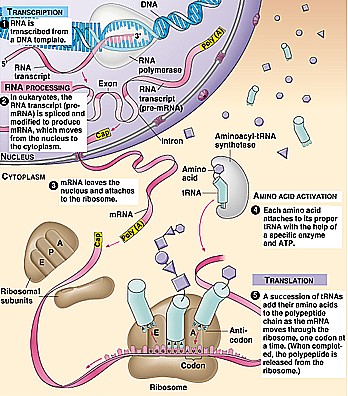
| This is the Transcription Initiation Complex Eukaryotes are different cause they have 3 different types of RNA polymerase |
| 2 | Elongation | - RNA Polymerase II | |
| 3 | Termination | AAUAA on RNA AATAA on the Sense/Coding Strand | In Prokaryotes RNA polymerase stop transcription right at the end of the terminator |
| *at the end of the process the pre-mRNA has to be modified to put a Guanine cap at the 5’ end. As well at the 3’ there is and enyzme that adds about 50-250 adenine nucleotides, Poly (A) tail.(protects from hydrolytic enzymes) | |||

| Translation | |||
| Acts | Names | Characters | Roles |
| 1 | Initiation (prokaryotic) | - 5‘AUG 3’
| Translation begins at the P site |
| 2 | Elongation | tRNA | - mRNA is read 5’ ->3’
|
| 3 | Termination | -DNA Polymerase I -Ligase | Stop Codons (UAA, UGA, UAG) |

No comments:
Post a Comment